
Offering Hope and Help
Unleashing “Superhero Survivors”
We unleash “superhero survivors” of abuse via trauma-informed, survivor-centered advocacy, while equipping the community for effective response to family violence.
Maze of
Coercive Control
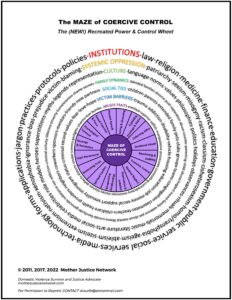
It’s not easy finding safety from someone who uses coercive control (tactics from luring and grooming, to economic control and medical neglect, to isolation and deprivation, to physical and sexual assault – and everything in between) to maintain their primary or dominant role in your relationship. On top of your partner’s abuse, every system has their laws, policies, rules, standards, applications, motives and myths that you have to somehow navigate.
Finding safely is not an event, it’s a process – a painstaking and painful process that takes the average victim 7 tries before she succeeds. It may be a decades-long process if you have children in common with your abuser. If you feel overwhelmed by the Maze of Coercive Control, you are not alone. It represents all kinds of factors that need to be considered for safety, and underscores that there are more barriers keeping you IN abuse, then there is help to get OUT.
Mother Justice Trainings and Tools
Maze of Coercive Control
Many Faces of Abuse
Why Don't They
Just Leave
If It Walks
Like a Duck
Children Who Live Domestic Violence

Behind Closed Doors:
Coerced Control is Out-Of-Control
Family violence is a common problem in the United States and around the world, affecting an estimated 10 million people every year; as many as one in four women and one in nine men are victims of domestic violence. Virtually all community professionals who regularly work with the public come into contact with a domestic abuse victim at least once per week. If you know more than 4 women or 9 men, you know at least one survivor. Coerced control includes economic, emotional, psychological abuse, and MAY include physical or sexual abuse; children, disabled adults, and elders are often targeted too. Coercive control worsens psychological and physical health, decreases quality of life, decreases productivity, and contributes to early mortality.
58,000
9 in 10
… female domestic abuse victims go through extreme emotional distress. — CLICK FOR SOURCE
(When we looked at the US domestic violence statistics more closely, we learned that more than 47% of them deal with PTSD, 20% get depressed, and over 14% live with anxiety.)
30% to 60%
Domestic violence and child maltreatment in the same family has a co-occurrence rate of between 30% and 60%. (Edleson, 1999) — CLICK FOR SOURCE
1 in 3
… women, globally, experience domestic or sexual violence in their lifetime . — CLICK FOR SOURCE
(Additionally, a 2003 study about the risks of firearms in the home found that females living with a gun in the home were nearly three times more likely to be murdered than females with no gun in the home. — CLICK FOR SOURCE)